How memory tests help track cognitive changes over time.

Memory tests measure how information is remembered and retrieved
These tests are widely used in scientific research and healthcare
The value lies mainly in repetition and comparison over time
Results are interpreted in context, not as standalone scores
Within Remind, the memory test is used for monitoring and insight, not for diagnosis
Memory is a core function of the brain. It enables us to absorb new information, retain it, and recall it later.
Memory tests are designed to measure these processes in a standardized way. They often assess:
the ability to remember words, images, or patterns
the ability to retrieve information after a short or long period
the ability to recognize previously presented information
This type of task provides insight into how efficiently the memory is functioning at that moment.
The memory tests used within Remind are based on academic research into how memory changes over time, and not just on a single measurement moment. This technology has been developed through a long-term collaboration between researchers at the University of Groningen and research groups in Seattle.
Speed of forgetting methodology
Central to this approach is the principle of speed of forgetting: not only what someone remembers at one moment is relevant, but especially how quickly information fades. Research shows that changes in this rate can be an early and sensitive indicator of cognitive change, often before clear complaints arise.
Unlike classic memory tests, which are usually a snapshot and often conducted in a clinical setting, this technology is designed for repeated use. By offering the same memory tasks at multiple times, a pattern over time emerges. This aligns with how memory changes develop in practice: gradually and subtly.
In scientific research and digital applications, short, repeatable memory tasks are often used. These are designed to:
take little time
be repeated multiple times
be sensitive to small changes
The memory tests used within Remind align with this type of research-based tasks.
It is important to note that these tests do not measure maximum performance but function as a measuring instrument over time.
Memory tests have been used for decades in research on cognitive functions and aging. In clinical settings, they support the conversation between patient and healthcare provider.
In research, memory tests are used to:
analyze differences between groups
make changes over time visible
track the effects of interventions
Memory tests also play an important role in studies on brain age and digital biomarkers because they are easy to standardize and repeat.

Memory tests play an important role in assessing brain health
A single memory test provides a snapshot. Factors such as fatigue, stress, or distraction can influence the outcome.
By regularly repeating the same test, a pattern emerges. This pattern is often more informative than a single score.
Repetition reveals:
what remains stable
where small changes occur
whether trends develop over a longer period
It is precisely this longitudinal perspective that makes memory tests valuable for tracking brain health.
On an individual level
Results are always viewed in relation to previous measurements. It's not about right or wrong, but about change compared to yourself.
On a population level
In research, results are compared between groups. This helps in understanding general patterns in aging and cognitive change.
Within Remind, individual results are never interpreted in isolation but always in combination with other signals such as lifestyle, speech, and other cognitive measurements.
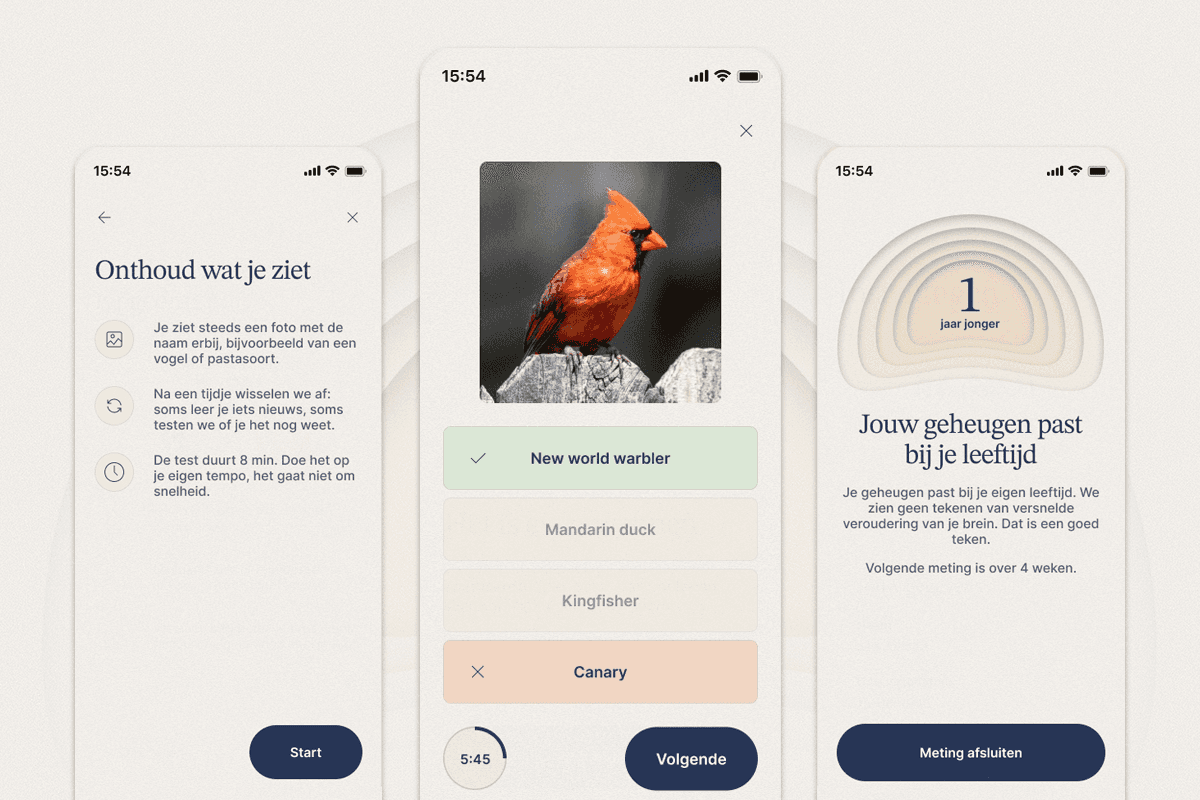
Example of the LIBRA lifestyle test in the Remind app
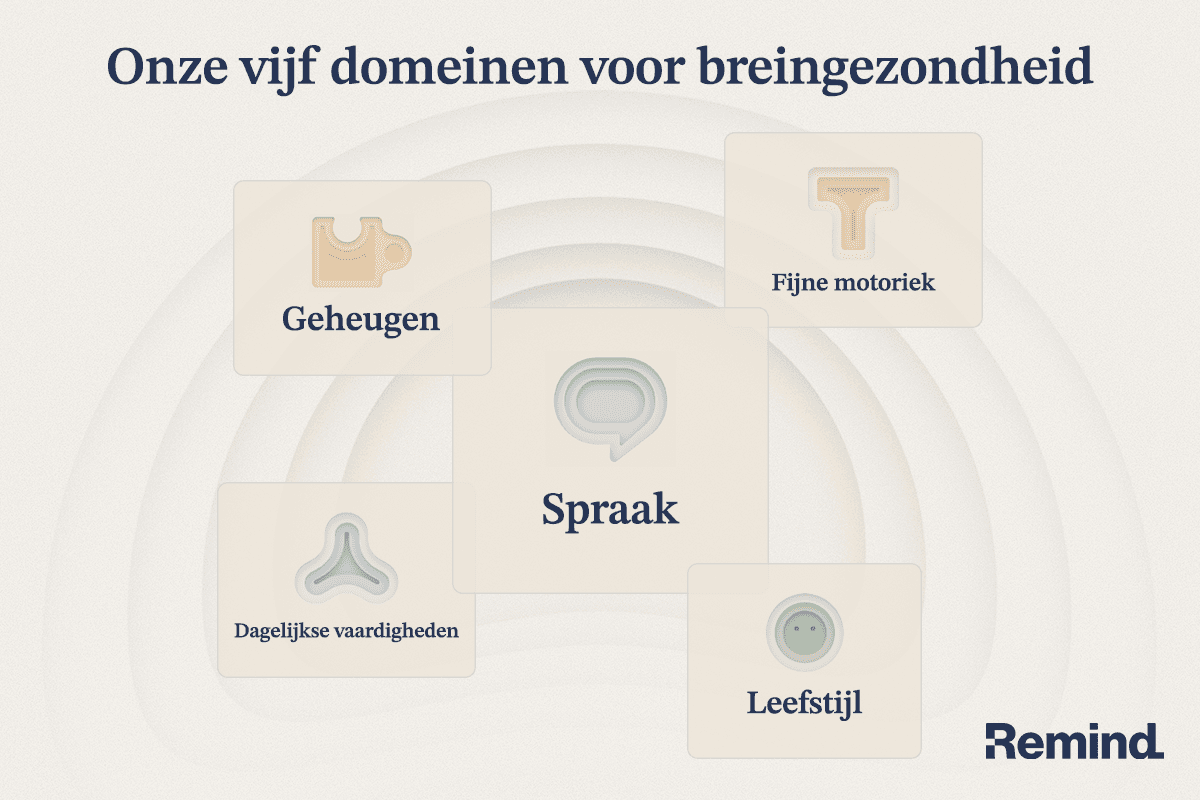
Remind combines multiple domains to better understand changes in brain health.
A memory test can provide valuable insights, but within Remind it is never considered in isolation from other information. Cognitive functions influence each other and are also affected by lifestyle and daily habits. That's why Remind uses a multi-modal approach.
Memory tests are combined with other digital measurements, such as lifestyle questionnaires and speech analysis. By examining these signals together, a richer picture of brain health emerges than would be possible with a single test. This helps to better track changes and to interpret results in a careful manner.
Memory tests provide an accessible and scientifically supported way to track cognitive functions. Through repetition and combination with other measurements, a richer picture of brain health over time is created.
Within Remind, the memory test is therefore used as part of a broader approach, focused on insight, context, and personal follow-up.
Share this article


Are you interested in the other assessments we offer at Remind? Read more here:




Frequently Asked Questions
How does Remind help me to recognize changes in my brain in a timely manner?
Is Remind the same as a medical examination or diagnosis?
How reliable are the tests used by Remind?
What happens to my data? Is someone listening or reading along?
What does my Remind Brain Age mean for me?