The A-IADL Questionnaire and Daily Skills
Scientific background, clinical use, and significance for cognitive monitoring.

Summary of this article
- Daily skills provide important signals about cognitive functioning
- The A-IADL is a scientifically validated questionnaire that measures these skills
- The questionnaire is used in research and clinical diagnostics
- Simplicity and recognition make repeated measurement possible
- Within Remind, A-IADL forms an essential part of the personal brain profile
- Combining multiple measurements provides a more reliable picture of brain health
What is the A-IADL questionnaire?
A-IADL stands for Amsterdam Instrumental Activities of Daily Living. It is a scientifically developed questionnaire that measures how someone functions in daily, more complex activities.
The questions are about, among other things:
- managing money and administration
- planning and organizing
- household tasks
- use of digital means
- independently arranging appointments
These activities require multiple cognitive skills at the same time, such as memory, attention, and planning. This is precisely why the A-IADL is sensitive to subtle changes in cognitive functioning.
The outcome is not a diagnosis, but a score that shows how someone is functioning and how this develops over time.

Clinical use in diagnostics and research
The A-IADL was developed by researchers at Amsterdam UMC and is used internationally in scientific research and memory clinics.
Multiple studies show that changes in daily skills:
- can occur early in cognitive decline
- are associated with the risk of dementia
- are relevant for monitoring disease progression
A frequently cited publication is that of Sikkes et al. in Alzheimer’s & Dementia (opent in een nieuw venster), demonstrating that the A-IADL is a valid and reliable way to measure daily functioning in various stages of cognitive decline.
In healthcare, the A-IADL is often used as a supplement to cognitive tests because it better shows how someone functions in daily life.
Why simplicity is actually powerful
The strength of the A-IADL lies in its simplicity. The questionnaire:
- is quick and easy to fill out
- aligns with recognizable everyday situations
- does not require medical knowledge
Precisely because the questions are about ordinary activities, small changes are often easily recognized by people themselves or their surroundings. This makes the A-IADL suitable for repeated use without becoming burdensome.
The role of daily skills in cognitive monitoring
Daily skills form an important indicator in brain health. They demonstrate how cognitive processes come together in daily life.
Research shows that changes in this domain often:
- occur gradually
- only later lead to clear complaints
- can be well monitored with repeated measurements
Therefore, this domain is valuable for monitoring over time. Not to draw conclusions based on a single moment, but to make patterns visible.

The role of A-IADL within Remind

Within Remind, the A-IADL is used as one of the building blocks of the personal brain profile.
Specifically, this happens in three ways:
**1. Insight into daily functioning **The outcome shows how someone experiences and performs their daily tasks. This provides context for other measurements.
**2. Supplement to other signals **Remind combines A-IADL results with other domains, such as memory, speech, and lifestyle. This helps to interpret signals better.
**3. Monitoring over time **Through repetition, it becomes visible whether daily skills remain stable or gradually change.
The results are explained step by step in the app, with attention to their meaning and context.
Multiple measurements together provide more insight
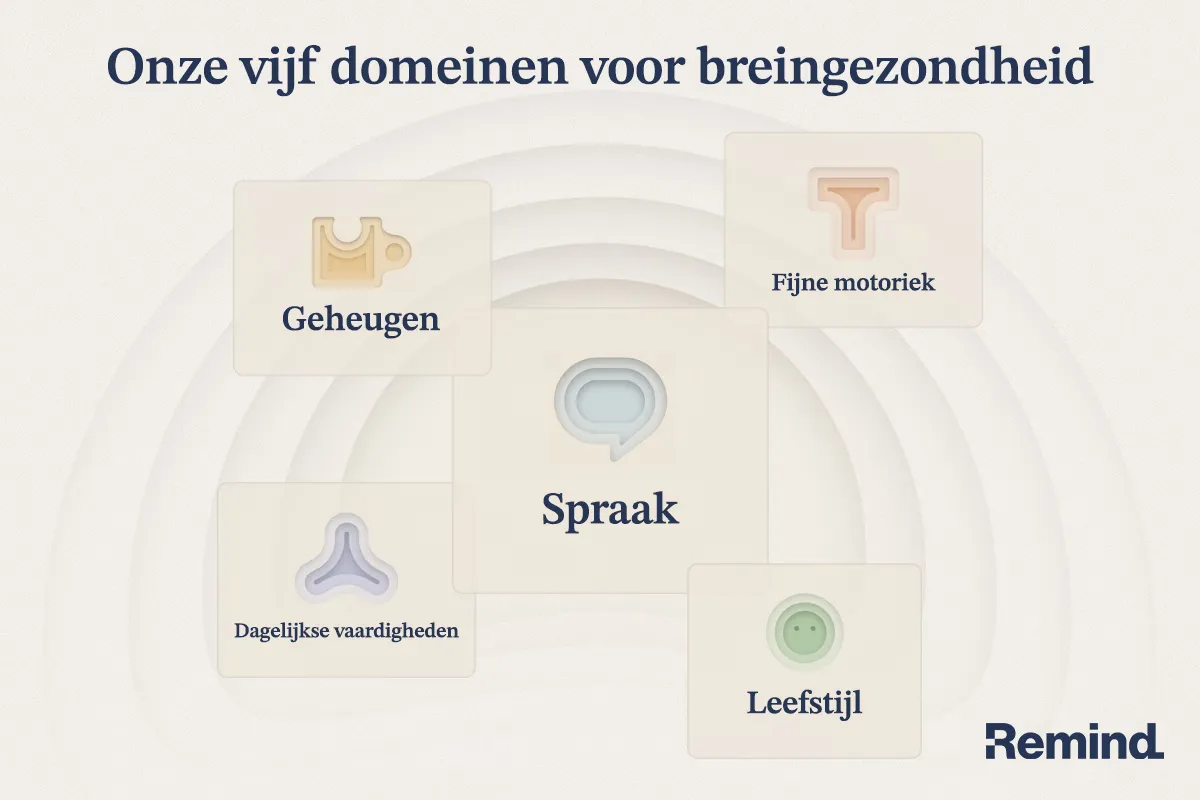
Remind distinguishes itself through a multi-modal approach. Cognitive changes do not manifest in one way and not in a single test.
By combining multiple signals, such as:
- daily skills
- memory tests
- speech analysis
- lifestyle and behavior
a richer and more reliable picture of brain health emerges. No single measurement stands alone, but together they enhance the interpretation.
In conclusion
The A-IADL questionnaire provides a scientifically validated and accessible way to track daily skills. Combined with other measurements, this helps to better understand changes in brain health over time.
Not to make diagnoses, but to provide insight and better support the conversation with healthcare professionals.
Read more
Interested in the other measurements Remind offers? Read on here:
-

Lifestyle
A growing body of research shows that dementia and cognitive decline are not determined by age or heredity alone. Lifestyle and health also play an important role.
Read more -

Speech
Speech seems self-evident, but it is neurologically complex. While speaking, multiple brain areas work together, among them those for language processing, planning, memory and motor skills.
Read more -
Fine motor skills
Fine motor skills and typing patterns give subtle signals about cognitive functioning. The Remind and Neurokeys keyboard measures how someone types, not what someone types.
Read more -

Memory
Memory is a core function of the brain. It allows us to take in new information, hold on to it and recall it later.
Read more
Frequently asked questions
How does Remind help me recognise changes in my brain in time?
Remind monitors multiple aspects of your brain health over time, such as thinking, memory, speech and daily functioning. By combining these signals you get a clear picture of what is normal for you and which changes deserve attention. This provides peace of mind and prevents you from reacting too late to subtle shifts.
Is Remind the same as a medical examination or diagnosis?
No. Remind is a wellbeing product and not a medical device. The app provides insight into patterns and changes but does not replace a doctor or a diagnosis. If you have concerns about your memory or functioning, always discuss your results with your GP.
How reliable are the measurement methods Remind uses?
Remind uses methods based on validated questionnaires and digital tests that are also applied in research and clinical settings. We combine multiple sources, such as speech, memory, behaviour and lifestyle, so that you do not get a single snapshot but a complete and reliable picture that grows as you use the app.
What happens to my data? Is anyone listening or reading along?
No. Remind never stores conversations or the content of messages. All data is processed with encryption, and we only use patterns such as pace, rhythm or accuracy, not content. You always decide which data you share and with whom.
What does my Remind brain age give me?
Your Remind brain age shows how your brain is functioning compared with what is normal for your age. You receive practical advice to strengthen your brain health and can see over time whether your actions have an effect. This helps you make informed choices and stay in control.