Speech analysis as a signal for brain health
How subtle changes in speech can help track cognitive health over time.

Summary of this article
- Speech contains subtle signals about how the brain processes information
- By regularly analyzing speech, changes over time can become visible
- The speech test is based on scientific research and is used as a digital biomarker
- The focus is on _how_ someone speaks, not _what_ they say
- Within Remind, speech is used for monitoring and context, not for diagnosis
Why speech can provide insight into brain health
Speech seems obvious, but it is neurologically complex. While speaking, multiple brain areas work together, including those for language processing, planning, memory, and motor skills.
Scientific research shows that with cognitive decline, very subtle changes often occur in speech, long before daily problems become apparent. Think of changes in tempo, pauses, or word usage.
Precisely because speaking is an everyday activity, speech lends itself well to tracking changes over time.
How speech functions as a digital biomarker
In a speech test, a short (60 seconds) spoken assignment is recorded. That recording is then analyzed using algorithms trained on large datasets.
Among other things, the analysis looks at:
- speech rate and variation
- pauses and patterns of silence
- fluency of sentences
- repetitions and self-corrections
These characteristics say something about information processing and cognitive load.
It’s important to note that a single measurement tells little. The value lies mainly in repetition and comparing measurements over time.
Research into digital biomarkers shows that this longitudinal nature contributes to the early detection of changes in brain function.
What is and isn’t analyzed
What is assessed:
- How someone speaks
- Structure and rhythm of speech
- Changes compared to previous measurements
What is not assessed:
- The content or meaning of what someone says
- Emotions, opinions, or intentions
- Individual diagnoses or conclusions
The speech test is not a listening tool where conversations are recorded and analyzed. The analysis is entirely focused on patterns in speech structure.
Clinical and scientific substantiation
Speech analysis as a digital biomarker has been investigated for some time in academic and clinical settings.
Research shows that speech patterns can be associated with cognitive changes. Research is also being conducted at academic centers, including Amsterdam UMC, into the use of speech as an objective and scalable biomarker.
In a doctoral research (opent in een nieuw venster) published in 2025 by Rosanne van den Berg (opent in een nieuw venster) (Amsterdam UMC), digital signals are examined that can contribute to monitoring cognitive functions over time.
Additionally, speech analysis aligns with broader developments around brain age and digital biomarkers, where multiple measurement methods are combined to better understand changes.

is a promising way to detect early signs of cognitive decline.
How does the speech model behind this test work?
Behind speech analysis lies a so-called algorithm or model. You can see it as a computational method that learns from examples. Instead of following fixed rules, the model is trained with large amounts of speech recordings from different people, linked to known outcomes from research and care.
With the speech model applied by Remind from Canary Speech (opent in een nieuw venster), it works as follows: the model analyzes thousands to millions of speech fragments and learns to recognize patterns in, among other things, tempo, pauses, variation, and articulation. These patterns are then compared with data from people with and without cognitive disorders. Thus, the model learns which combinations of characteristics occur more frequently with certain forms of cognitive change.
Importantly, the model does not listen to the content of what someone says, but to how someone speaks. The meaning of words is therefore not relevant, only the way in which speech is produced.
Applied more widely than just dementia and Alzheimer’s
In research and specialized care contexts, this type of model is studied and applied in various neurological and psychiatric disorders, including Alzheimer’s, mild cognitive impairment, and Parkinson’s. Within Remind, this technology is used exclusively for non-diagnostic monitoring of changes over time.
Applications in clinics and hospitals by Microsoft
This technology is now also used in clinical practice. In the United States, speech analysis is applied within medical documentation, for example via Microsoft DAX Copilot (opent in een nieuw venster). There, speech technology is used to assist doctors during consultations, with research also investigating how speech characteristics can contribute to recognizing cognitive load and change in patients.
Within Remind, the same scientific foundation is applied, but in a more accessible, repeatable form. By analyzing speech at multiple points in time, insights into changes over time are gained, which aligns with how cognitive decline usually develops: gradually and subtly.
The role of speech analysis within Remind
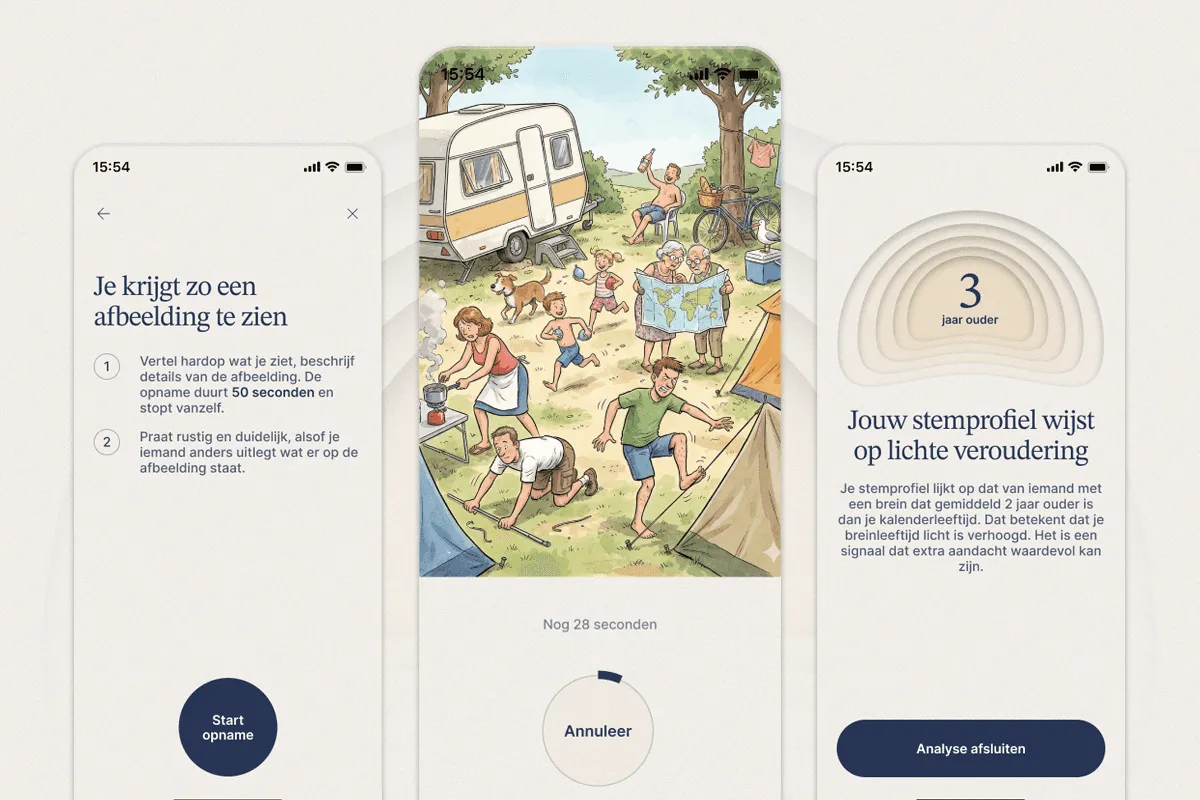
Within Remind, the speech test is used as one of several indicators.
Concretely, this occurs in three ways:
- **Starting point for monitoring **The first speech test provides a personal reference point.
- **Tracking changes over time **Through repetition, subtle trends can become visible without drawing conclusions based on one moment.
- **Context with other measurements **Speech, combined with lifestyle, cognitive tests, and other digital signals, forms a broader picture of brain health.
Within the app, these insights are presented step by step, with room for explanation and context.
What you should and shouldn’t expect from a speech test
The speech test is not:
- a medical diagnosis
- a prediction
- an assessment of how “well” someone speaks
It is precisely because of these limitations that speech can play a safe and valuable role in monitoring brain health.
Speech as part of a broader whole
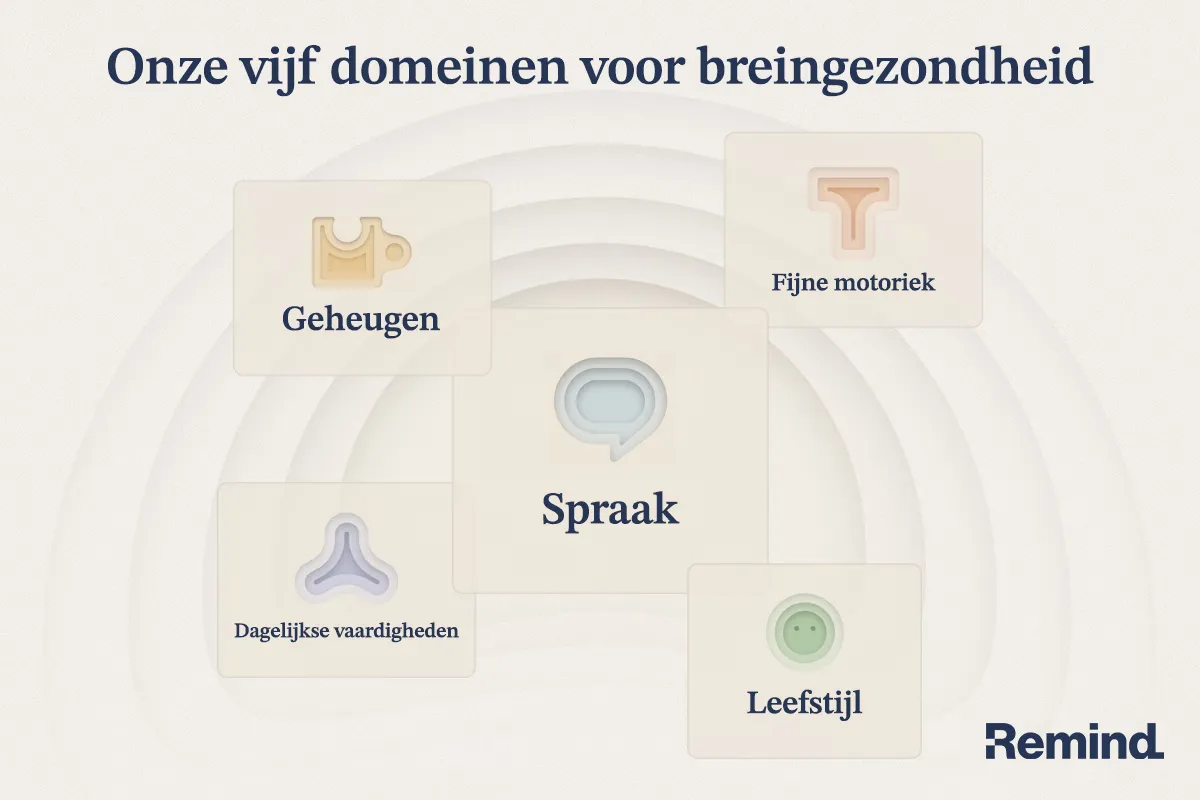
Speech analysis is never a standalone signal within Remind. Changes in brain health often manifest on multiple levels simultaneously. That’s why Remind deliberately chooses a multi-modal approach, combining speech with other measurements.
Speech patterns are examined in conjunction with lifestyle, memory tests, and other cognitive signals. This prevents conclusions from being drawn based on a single measurement method and helps to better understand subtle changes. The strength lies not in one test, but in bringing together multiple perspectives over time.
In conclusion
Speech is a natural, daily function in which the brain is continuously active. By analyzing speech in a careful and scientifically substantiated manner, an additional way emerges to monitor changes in brain health over time.
Within Remind, speech is therefore used as a digital biomarker: supportive, contextual, and always in combination with other insights.
Read more
Interested in the other measurements Remind offers? Read on here:
-

Lifestyle
A growing body of research shows that dementia and cognitive decline are not determined by age or heredity alone. Lifestyle and health also play an important role.
Read more -
Fine motor skills
Fine motor skills and typing patterns give subtle signals about cognitive functioning. The Remind and Neurokeys keyboard measures how someone types, not what someone types.
Read more -

Memory
Memory is a core function of the brain. It allows us to take in new information, hold on to it and recall it later.
Read more -

Daily skills
Daily skills give important signals about cognitive functioning. The A-IADL is a scientifically validated questionnaire that measures these skills.
Read more
Frequently asked questions
How does Remind help me recognise changes in my brain in time?
Remind monitors multiple aspects of your brain health over time, such as thinking, memory, speech and daily functioning. By combining these signals you get a clear picture of what is normal for you and which changes deserve attention. This provides peace of mind and prevents you from reacting too late to subtle shifts.
Is Remind the same as a medical examination or diagnosis?
No. Remind is a wellbeing product and not a medical device. The app provides insight into patterns and changes but does not replace a doctor or a diagnosis. If you have concerns about your memory or functioning, always discuss your results with your GP.
How reliable are the measurement methods Remind uses?
Remind uses methods based on validated questionnaires and digital tests that are also applied in research and clinical settings. We combine multiple sources, such as speech, memory, behaviour and lifestyle, so that you do not get a single snapshot but a complete and reliable picture that grows as you use the app.
What happens to my data? Is anyone listening or reading along?
No. Remind never stores conversations or the content of messages. All data is processed with encryption, and we only use patterns such as pace, rhythm or accuracy, not content. You always decide which data you share and with whom.
What does my Remind brain age give me?
Your Remind brain age shows how your brain is functioning compared with what is normal for your age. You receive practical advice to strengthen your brain health and can see over time whether your actions have an effect. This helps you make informed choices and stay in control.