The importance of lifestyle and prevention for brain health
What research says about lifestyle and your risk of dementia.

Summary of this article
- How lifestyle plays an important role in the prevention of dementia
- According to the Lancet Commission (2024), around 45% of cases are linked to risk factors you can influence
- The various studies are widely supported internationally
- Within Remind, lifestyle is the starting point, but effects are continuously monitored and advice is provided on what you can do
At the bottom of this page, you will find an overview of the specific domains you can influence. Tap or click the button to view it.
Go to the overview of all lifestyle articlesHeredity and lifestyle: What can you influence, and what can’t you?
Part of the risk of dementia, including Alzheimer’s disease, is determined by hereditary predisposition. Genetic factors such as the APOE-ε4 gene can increase the risk. You cannot change that predisposition.
At the same time, more and more scientific research shows that heredity is not the whole story. Even among people with an increased genetic risk, lifestyle appears to play an important role.
Factors such as exercise, nutrition, sleep, cognitive activity, and cardiovascular health influence the likelihood that cognitive decline will actually develop.
In other words: genes determine part of the risk, but lifestyle largely determines how that risk develops in practice.
What does scientific research say about prevention?
Over the past ten to fifteen years, prevention of cognitive decline has become an important area of research. The focus is shifting from a single factor to a combination of lifestyle interventions.
An influential series of publications on this topic has appeared in The Lancet (opent in een nieuw venster). The Lancet Commission on Dementia Prevention, Intervention and Care concludes that an estimated approximately 45 percent of dementia cases are related to fourteen modifiable risk factors over the lifespan.
The FINGER Study: Design and Outcomes
One of the most cited and influential prevention studies is the FINGER study (Finnish Geriatric Intervention Study to Prevent Cognitive Impairment and Disability).
What was investigated?
In this large-scale, randomized study, more than 1200 older adults were followed who had an increased risk of cognitive decline. The intervention group received a multidomain lifestyle program, consisting of:
- nutrition advice
- structured physical training
- cognitive training
- intensive monitoring of cardiovascular risk factors
The control group received standard health information.
What were the results?
After two years, the intervention group showed:
- better cognitive performance
- less decline in memory, processing speed, and executive functions
- better physical and general health
Importantly, it was not about preventing dementia in the short term, but about slowing cognitive decline and enhancing cognitive resilience.
Publication:
Prevention in practice - a process, not a one-time action
The FINGER study shows that a combined approach is more effective than separate interventions. It’s not a single lifestyle factor, but rather the synergy that makes the difference.
This aligns with how brain health develops in daily life: over time, through habits, behavior, and context. Prevention is therefore not a one-time action, but a process.
FINGER-NL and international follow-up studies
The FINGER model has now been adopted internationally.
Netherlands: FINGER-NL
In the Netherlands, the FINGER-NL study is underway, examining how this approach works within the Dutch healthcare context and lifestyle patterns.
More information:
United States and worldwide
In the United States and other countries, the FINGER model is also being replicated and adapted to local circumstances. This is done under the banner of the World-Wide FINGERS network, where researchers worldwide collaborate on prevention research.
What does this say about your brain health?
Science shows that lifestyle is no guarantee against dementia, but it does indeed influence the risk and progression of cognitive changes. By identifying risks and protective factors early, there is an opportunity for targeted and achievable adjustments.
Lifestyle interventions are therefore not a replacement for medical care, but an important supplement that gives people more control over their brain health.
How Remind implements lifestyle and prevention in practice
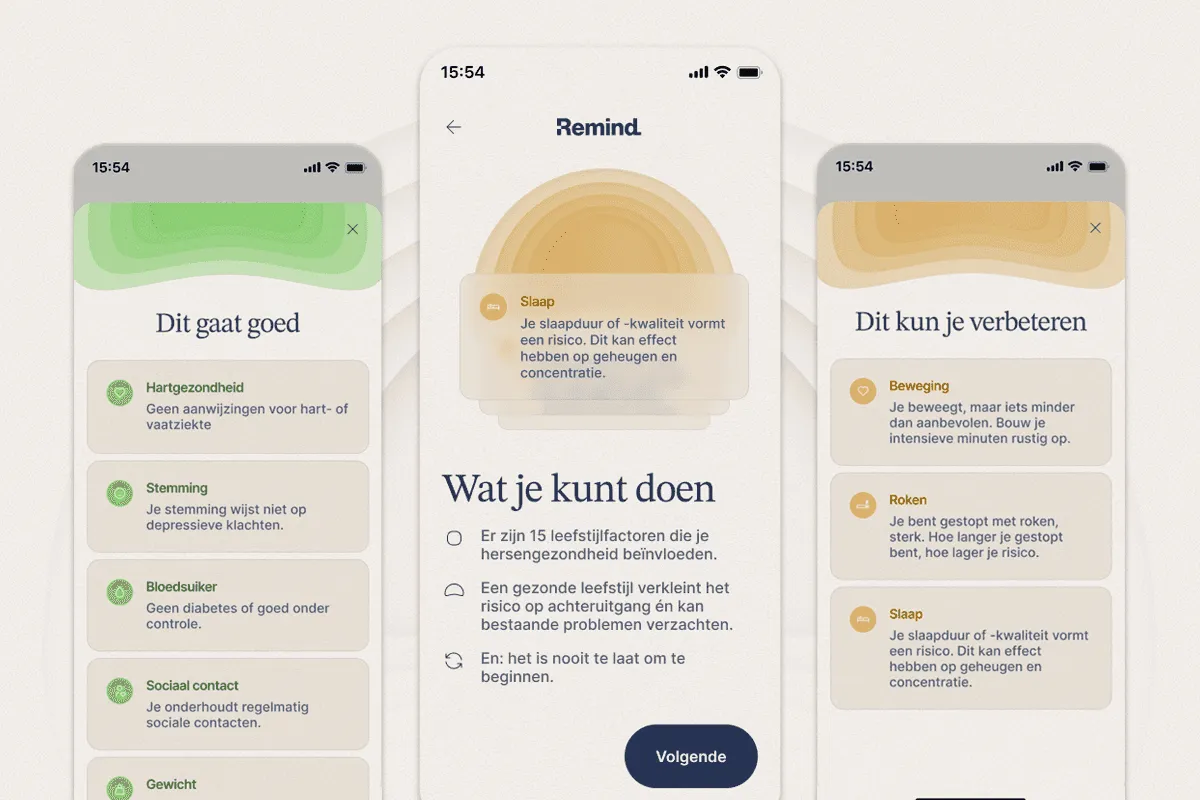
Research such as the FINGER study and publications in The Lancet show that lifestyle interventions have the most effect when they are applied consistently and over a longer period of time.
Lifestyle integrated into the app, continuously monitored
Remind aligns with this by not approaching lifestyle as a one-time measurement, but as something that is followed in conjunction with other signals.
Within Remind, lifestyle factors are combined with repeated measurements to make changes visible and place lifestyle choices in context.
In this way, Remind supports a preventive approach that aligns with what scientific research shows: not a single intervention, but consistent attention and monitoring over time.
Sources
The most important modifiable lifestyle factors
At Remind we have gathered the 15 most important modifiable lifestyle prevention factors for you. You can look at each one separately and read about the ways to deal with it:


Measurement methods from scientific research
The measurements in the Remind app are based on researched instruments. For each one you can read here where it comes from and how far the research goes.